
Are Yak Chews Safe for Dogs?

Yak chews have become one of the most popular long-lasting dog chews in the US, and the first question every new buyer asks is the same one: are yak chews actually safe for my dog?
The short answer is yes, yak chews are safe for most dogs when you choose the right size and follow basic supervision guidelines. But there are a few things worth understanding before you hand one over, especially if you have a puppy, a senior dog, or an especially aggressive chewer.
This guide covers everything you need to know: what yak chews are made of, how they compare to other chews on the safety scale, what the real risks are (and how to avoid them), and how to pick the right one for your specific dog.
What Are Yak Chews Made Of?
Before asking whether something is safe, it helps to know what it actually is.
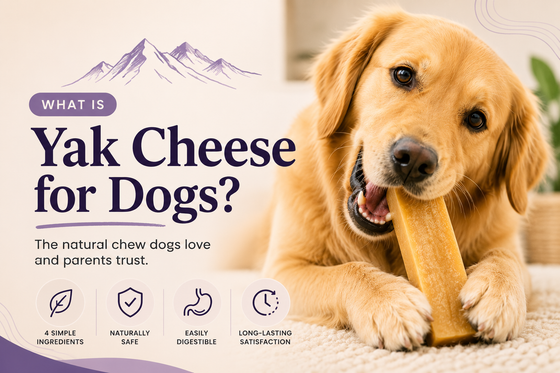
Yak chews, sometimes called Himalayan chews or chhurpi chews, are made from yak milk using a centuries-old process from Nepal. At Yak Chew Plus, our Heritage Original contains just four ingredients: yak milk, lime juice, salt, and baking soda. That is the complete list.
There are no preservatives, no artificial flavors, no binding agents, no chemicals, and no fillers. The chew gets its hardness not from additives, but from the traditional drying process, where the cheese is pressed and then sun-dried for weeks until it reaches a rock-hard consistency.
Compare that to rawhide, which goes through an extensive industrial processing chain involving chemicals like hydrogen peroxide, bleaching agents, and artificial flavoring to make it palatable. Yak chews are about as clean as a dog chew gets.
The ingredient list is the first reason yak chews score so well on safety: you know exactly what is in them.
Are Yak Chews Digestible?
One of the most common concerns with hard chews is what happens if a dog swallows a piece. With yak chews, this is much less of a concern than with rawhide or actual bones.
Yak chews are made from compressed cheese, which is a protein-based food your dog's digestive system is designed to handle. The primary protein in yak milk is casein, a slow-digesting protein that breaks down gradually in the stomach. Small pieces that are chewed off and swallowed are digested normally, just like any other dairy-based food.
Yak chews are also naturally low in lactose. The traditional chhurpi process removes most of the lactose during production, so dogs with dairy sensitivities typically tolerate them well. If your dog has never had any dairy-based treats before, start with shorter chew sessions and watch for any digestive upset, but the vast majority of dogs have no issues at all.
The key distinction is between small pieces chewed off during normal use (fine) and a large chunk that could cause a blockage (a risk worth managing). That is covered in the supervision section below.
What Are the Real Risks?
Yak chews are among the safest long-lasting chews available, but no chew is 100% risk-free. Here is an honest look at the real risks and how to manage each one.
Choking and Blockage
The main risk with any hard chew is that a dog chews off a piece that is too large to swallow safely. This is more likely with:
- Very aggressive chewers who try to bite off big chunks rather than gnawing steadily
- Dogs who are given a chew that is too small for their size (a piece sized for a small dog becomes a swallowing risk for a large dog)
- Dogs left unsupervised with a chew for extended periods
The solution is straightforward: size correctly (more on this below), supervise during chew sessions, and take the chew away when it gets gnawed down to a small nub.
Tooth Fractures
Hard chews can cause tooth fractures in dogs with pre-existing dental conditions or in dogs who chew with extreme force. Veterinary dentists sometimes recommend the "thumbnail test": if you press your thumbnail firmly into the chew and it does not indent at all, it may be too hard for some dogs. Yak chews do pass this test, as they have some flexibility in structure compared to antlers or actual bones.
If your dog is an especially forceful chewer or has known dental issues, consult your vet before introducing any hard chew.
The Small Nub Problem (and the Solution)
As a yak chew gets chewed down over time, it reaches a point where it is small enough to be a swallowing risk but still too hard to be eaten safely. Do not throw it away.
Here is what to do: wet the nub, place it on a microwave-safe plate, and microwave it for 45 seconds. The remaining piece puffs up into a light, crunchy, fully edible treat your dog can enjoy safely. Nothing is wasted, and the risk is completely eliminated.
How to Choose the Right Size
Sizing is the most important safety decision you make when buying a yak chew. A chew that is too small for your dog becomes a choking hazard. A chew that is too large is not necessarily unsafe, but it may be harder for a small dog to hold and work comfortably.
At Yak Chew Plus, we size by dog weight:
- XS: 5 to 11 lbs (Chihuahuas, Toy Poodles, small Yorkies)
- Small: 11 to 22 lbs (Pugs, Shih Tzus, French Bulldogs)
- Medium: 22 to 40 lbs (Beagles, Cocker Spaniels, Bulldogs)
- Large: 40 to 55 lbs (Labrador Retrievers, Border Collies)
- XL: 55 to 77 lbs (German Shepherds, Huskies)
- XXL: 77 lbs and over (Great Danes, Mastiffs, Saint Bernards)
When in doubt between two sizes, go up. A chew that is slightly larger than needed is always safer than one that is slightly too small.
Are Yak Chews Safe for Puppies?
Yak chews are generally appropriate for puppies over six months of age. Before six months, puppies are still developing their adult teeth, and hard chews of any kind can put stress on teeth that are not yet fully set.
After six months, size selection becomes even more important for puppies than for adult dogs. Puppy jaws are still developing, so choose the size that matches your puppy's current weight rather than their expected adult weight.
Supervision during chew sessions is especially important for puppies, who may be more likely to try to swallow pieces rather than chew them down methodically.
Are Yak Chews Safe for Senior Dogs?
Most senior dogs can enjoy yak chews without issue, but there are a couple of things to keep in mind.
Senior dogs sometimes have weaker teeth or existing dental problems. If your senior dog has had any dental issues, check with your vet before introducing a hard chew.
Senior dogs may also chew more slowly and with less force than younger dogs, which is actually a benefit from a safety standpoint. Slower, more deliberate chewing is the safest way to work through a yak chew.
If your senior dog is in good dental health, a correctly-sized yak chew is one of the best options for mental enrichment and jaw muscle engagement. For senior dogs who might benefit from additional joint support, our Functional Collection includes a yak chew formulated with added ingredients that support joint and mobility health.
How Do Yak Chews Compare to Other Chews?
Here is a quick comparison of yak chews against the most common alternatives:
Rawhide: Made from chemically processed animal hide. Not easily digestible. Known risk of swallowing large pieces that can cause blockages. Many vets advise against rawhide entirely.
Real Bones (cooked): Cooked bones become brittle and can splinter, creating sharp fragments that can cause internal injuries. Most vets and the FDA specifically recommend against cooked bones.
Raw Bones: Safer than cooked, but still carry risks of bacterial contamination (Salmonella, E. coli) and can cause tooth fractures. Require careful handling and storage.
Bully Sticks: Made from dried beef pizzle. Fully digestible and generally safe. Softer than yak chews, so they do not last as long. Can have a strong odor. Calorie-dense.
Antlers: Very hard, with almost no flex. Higher risk of tooth fractures than yak chews. Not digestible if pieces break off.
Yak Chews: Naturally low in lactose, four simple ingredients, digestible when pieces are chewed off, no chemical processing. One of the safest options in the long-lasting chew category.
Safe Chewing Guidelines: A Quick Summary
Following these simple practices makes yak chews as safe as they can be:
Choose the right size. Match the chew to your dog's weight. When between sizes, go larger.
Supervise chew sessions. Stay nearby for at least the first few sessions until you know how your dog chews. Check in regularly during longer sessions.
Take the chew away when it gets small. When the chew is worn down to a piece small enough to swallow whole, remove it.
Use the microwave trick. Wet the nub, microwave for 45 seconds, and let it cool before giving it back as a puffed treat.
Introduce gradually. Let your dog chew for 15 to 20 minutes the first time to see how they respond before allowing longer sessions.
Keep fresh water available. Any chewing session should be accompanied by access to clean water.
Final Thoughts
Yak chews are one of the safest long-lasting chews available for dogs. They are made from four simple, natural ingredients, they are digestible, they contain no chemicals or artificial additives, and they are naturally low in lactose. The risks that do exist, including choking and tooth fractures, are manageable with proper sizing and basic supervision.
For most healthy adult dogs, a correctly-sized yak chew is a safe, nutritious, and deeply satisfying chewing experience. For puppies over six months, senior dogs in good dental health, and dogs of any size and breed, the key is simply choosing the right size and staying aware during chew sessions.
Join the conversation