
Yak Cheese for Dogs: What It Is, Why It's Safe, and Why Dogs Go Wild for It

You may have seen yak cheese dog chews at your local pet store or spotted them on social media, usually in a video of a dog gnawing contentedly on a dense, hard, straw-colored block for an impressively long time. Maybe you picked one up, looked at the ingredient list, and thought: four ingredients? That cannot be right.
It is. And that simplicity is exactly the point.
Yak cheese for dogs is one of the oldest dog treats in existence, and one of the newest trends in the US pet market at the same time. Here is what it actually is, where it comes from, why it is so safe, and why dogs respond to it the way they do.
What Is Yak Cheese for Dogs?
Yak cheese dog chews are made from the milk of yaks, a large bovine animal native to the Himalayan plateau region of Nepal, Tibet, Bhutan, and surrounding areas. The cheese is produced using a traditional method called chhurpi, which has been made and consumed in the Himalayan region for centuries, both as a human food and as a long-lasting energy source for people working at high altitude.
In the version made for dogs, the chhurpi process produces a very hard, dense block of dried cheese that is tough enough to occupy even aggressive chewers for extended periods of time.
The key things that distinguish yak cheese chews from other pet chews:
- Made from actual food ingredients (cheese) rather than processed animal hide or synthetic materials
- Extremely hard due to traditional pressing and drying, not chemical hardening
- Digestible as a cheese-based protein product
- Naturally low in lactose due to the production process
- Minimal ingredient list: typically just yak milk, lime juice, salt, and baking soda
How Is Yak Cheese Made?
The chhurpi process starts with yak milk, which is naturally richer in fat and protein than cow's milk. The milk is boiled and a small amount of lime juice is added to cause the milk proteins to curdle and separate from the whey.
The curds are then strained, pressed to remove as much moisture as possible, and formed into blocks or shapes. These blocks are left to dry and harden over an extended period, sometimes several weeks, in conditions that allow them to lose most of their remaining moisture content. The result is an extremely hard, almost stone-like block of dried cheese.
Baking soda is added in small amounts during the process, which serves a functional role in the texture and helps with the drying. Salt is also added, both for preservation and to enhance the mild flavor that dogs find appealing.
What the process does not include: chemical preservatives, bleaching agents, artificial flavors, binding agents, or fillers of any kind. The hardness of the final product comes entirely from the pressing and drying, not from anything added to the cheese.
This is why ingredient lists on quality yak chews are so short. There is simply nothing else in them.
Is Yak Cheese Safe for Dogs?
Yes. Here is why.
It is a food product. Unlike rawhide (processed animal hide) or nylon chews (synthetic polymer), yak cheese is an actual food. The primary protein is casein, a dairy protein that dogs digest through the same mechanisms they use to digest any protein-based food.
It is naturally low in lactose. Lactose intolerance in dogs is a real concern, but the chhurpi process removes most of the lactose during production as the whey is strained away. The final product contains very low lactose levels, well below what typically causes digestive upset in lactose-sensitive dogs. The vast majority of dogs tolerate yak chews without any digestive issues.
It does not splinter. Unlike cooked bones (which can produce sharp, dangerous fragments) or antlers (which can produce sharp edges under extreme chewing), yak cheese wears down gradually through gnawing. Pieces that are chewed off are small, rounded, and digestible. They do not create sharp fragments.
No chemical processing. The ingredient list is the safety record. When a product contains four natural food ingredients and nothing else, there is no chemical residue, no artificial preservative, and no processing agent to account for.
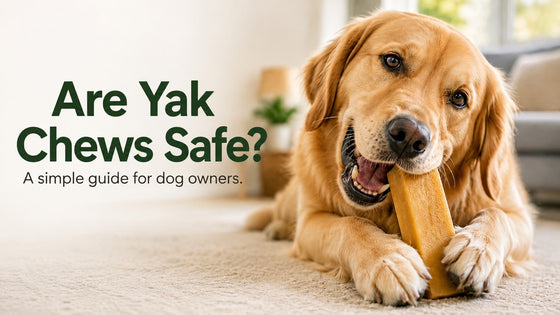
The main safety consideration is sizing: choosing a chew large enough for your dog's weight so that they cannot swallow the whole chew. When the chew wears down to a small nub, there is a simple solution (see below).
Why Do Dogs Go Wild for Yak Cheese Chews?
If you have watched a dog encounter a yak chew for the first time, the reaction is often one of intense, sustained interest. Why?
The smell. Yak cheese has a mild but persistent dairy-protein scent that dogs find highly attractive. It is not a loud, artificial smell like some flavored chews, but rather a low-level, constant scent signal that keeps dogs engaged over long sessions.
The texture. Hard chews satisfy a deep instinctual drive in dogs. The resistance of a yak chew allows a dog to apply real chewing force in a sustained way, which releases endorphins and provides significant mental stimulation. Softer chews that are consumed quickly do not provide the same level of satisfaction.
The duration. Because yak chews are so hard, the experience lasts a long time. A dog does not get that abrupt ending that happens when a bully stick or soft treat is finished in minutes. The extended chewing session itself becomes rewarding.
The taste. Yak cheese has a mild, savory flavor from the natural cheese proteins and salt. It is not flavored artificially, but the natural taste is enough to keep most dogs highly motivated.
Dogs that are given yak chews consistently often develop a clear preference for them over softer chews, not because they are trained to prefer them, but because the sustained engagement and satisfaction they provide is genuinely more rewarding.
The Microwave Trick: What to Do with the Nub
One of the most distinctive things about yak cheese chews is what happens at the end. As a dog works through a chew over multiple sessions, it gets worn down to a small piece, roughly the size of a large marble or small egg. At this point, the piece is too small to chew safely (a swallowing risk) but still too hard to eat.
Here is what you do: wet the nub under the tap, place it on a microwave-safe plate, and microwave it on high for about 45 seconds. The piece puffs up dramatically into a light, airy, crunchy puff treat that your dog can eat safely and completely. The transformation is remarkable and dogs absolutely love the puffed result.
This is unique to yak cheese chews. No other hard chew has this feature. It means you get the maximum possible value from every single chew: a long, satisfying chewing session followed by a completely edible treat at the end. Nothing is wasted.
Yak Cheese vs. Regular Cheese Chews
You may have seen "cheese chews" for dogs made from cow's milk or goat's milk. How do these compare?
The key differences are the milk source and the production method. Yak milk is naturally higher in protein and fat content than cow's milk, which contributes to a denser, harder final product. The traditional chhurpi pressing and drying process also produces a harder result than most commercial cheese treat production methods.
Regular cheese dog treats are typically much softer, more like a cheese stick than a hard chew block. They are consumed quickly rather than worked on over extended sessions. They can be a nice treat, but they do not provide the extended chewing experience that makes yak cheese chews valuable for dogs with high chewing drive.
How to Choose the Right Yak Cheese Chew for Your Dog
At Yak Chew Plus, we offer yak cheese chews in six sizes to match every dog's weight and jaw size:
- XS (5 to 11 lbs): Chihuahuas, Toy Poodles, petite breeds
- Small (11 to 22 lbs): French Bulldogs, Pugs, Shih Tzus
- Medium (22 to 40 lbs): Beagles, Cocker Spaniels, Bulldogs
- Large (40 to 55 lbs): Labrador Retrievers, Border Collies, Boxers
- XL (55 to 77 lbs): German Shepherds, Huskies, Golden Retrievers
- XXL (77 lbs and over): Great Danes, Mastiffs, Saint Bernards
When in doubt between two sizes, choose the larger one. A chew that is slightly larger than your dog needs is always safer than one that is slightly too small.
We also offer yak cheese chews in five natural flavors through our Infused Collection: Peanut Butter, Pumpkin Spice, Blueberry, Strawberry, and Turmeric. All use the same traditional chhurpi base, with natural flavors infused during production. Great for dogs that respond strongly to specific flavor profiles.
Frequently Asked Questions About Yak Cheese for Dogs
Can all dogs eat yak cheese chews?
Most healthy adult dogs can enjoy yak cheese chews. They are not recommended for puppies under six months (whose teeth are still developing) or for dogs with known dental fractures or significant dental disease. If your dog has a health condition, consult your vet before introducing any new chew.
How often can I give my dog a yak cheese chew?
Most dogs do well with one chew session per day of 20 to 30 minutes. Yak chews are relatively low in calories compared to their size and duration, but as with any treat, moderation is appropriate. Monitor how much of the chew your dog works through per session and adjust frequency based on your dog's overall diet.
My dog has been ignoring it. What do I do?
Some dogs, especially those accustomed to softer chews, need a short introduction period. Try soaking the end of the chew in warm water or low-sodium broth for a few minutes before offering it. This softens the surface slightly and releases the scent. Most dogs that initially ignore a yak chew become enthusiastic about it within a few sessions.
Is yak cheese the same as Himalayan dog chew?
Yes. "Himalayan dog chew," "yak cheese chew," "yak chew," and "chhurpi chew" all refer to the same product. The naming varies by brand, but the core product is the same traditional yak milk cheese prepared using the chhurpi method.
Join the conversation